On Doing and Having Done
How to Do a Thing
There are, fundamentally, two steps do doing anything: 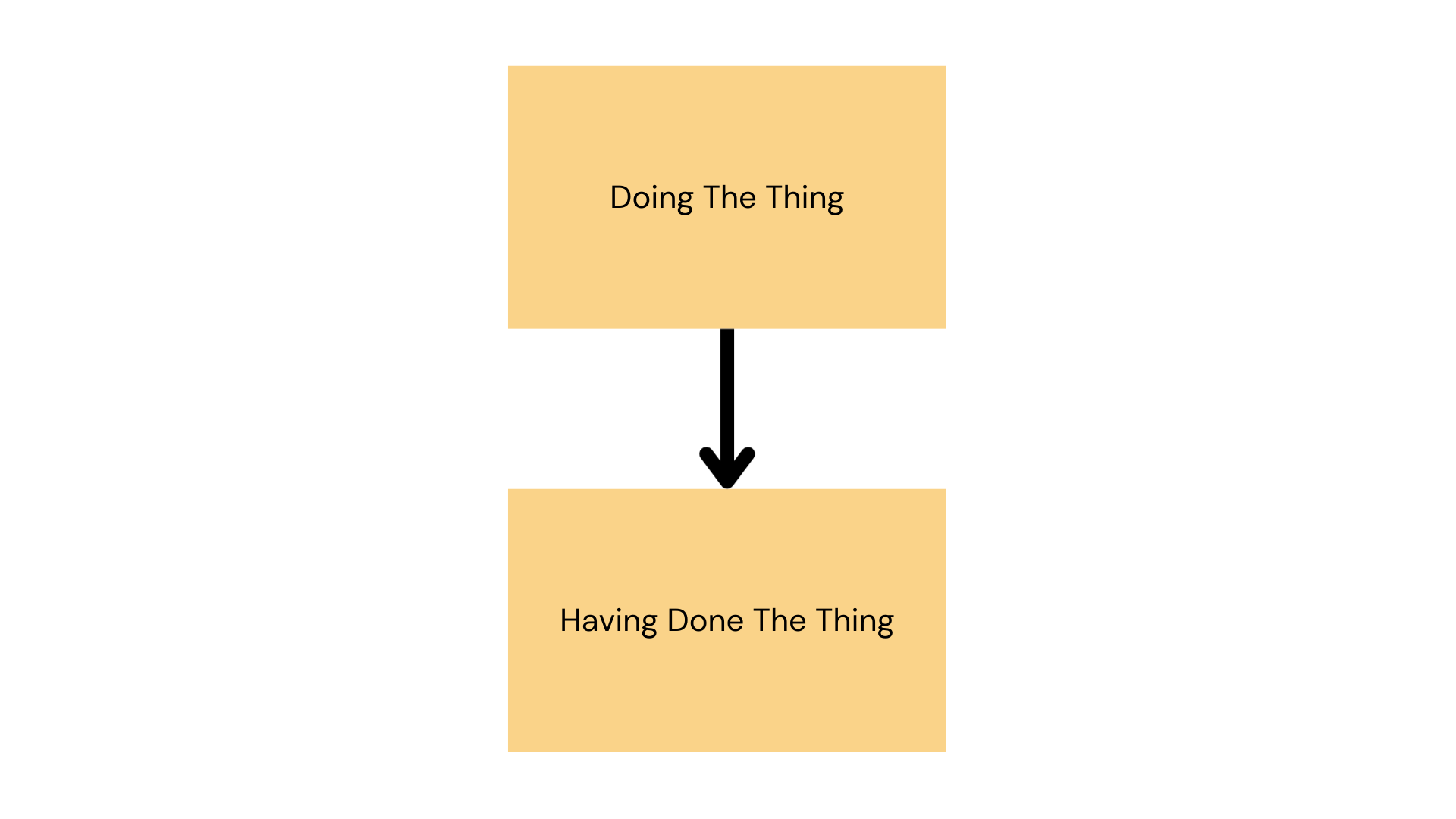
First, you do the thing. This part is difficult. It takes a lot of time, and often, it requires you to repeatedly fail at doing the thing. It is uncomfortable for many people. Additionally, doing the thing requires time, energy, money, connections, and know-how. These things can be hard to come across, especially if you don't know where to look.
Second, the thing has been done. In this part, you have whatever artifacts arise from doing the thing. In many cases, they nominally last forever. This is usually the part other people see. It's easy to have done something. There's no more room to mess it up or make a fool of yourself with it.
Let's go through a concrete example of this. Let's say I decide to write a novel. First, I do the thing, I write the novel. This takes me many months or even years. Through the process, I find it necessary to scrap sentences, paragraphs, and even entire chapters because they don't fit into my overall vision of the book. I have to suffer through editing and revisions to make this story the best it can be.
Now, once that's all done, I have done the thing. I wrote the novel. I can show it off to friends or family members. When they point out parts they don't like, I can easily ignore the idea of going back and changing it because writing the novel is no longer in my present; it's in the past. There's no more to be done. Also, this is the part where I make could money from the book. Making it was expensive, but having made it is profitable.
I really want to emphasize the change in verb tense here. At some point, anything you do moves from the present to the past. Over the course of my life, I've learned not to care about having done things, but rather only about doing things. It seems like other people disagree with me.
Why to Do a Thing
The way I just described it, doing things sounds awful. The present is where everything bad about doing things lies. It's where you encounter all the challenges and setbacks of doing work. Perhaps worse, it requires moving through uncharted territory. You don't know up front how what you're doing will turn out.
On the contrary, having done things sounds pretty great. You have an artifact to show off. You can put it on your resume. It demonstrates that you possess Skills. Having done a thing, you know everything about it. There's no uncertainty left, there's no way to fail, and it sucks.
Anything I've done is an empty shell of what it was when I was doing it. As an example, take code. Code, the artifact of having coded, is basically worthless. It is inflexible and brittle. If it is within an organization, it is only a cost. Sure, it provides valuable capabilities, but the code itself, the artifact, might as well be a cask of radioactive waste.
The most valuable thing that comes out of coding is the understanding. Understanding can only be developed by doing. You can read as many books as you want, or listen to every podcast in the world, but if you've never coded then you cannot understand how to do it. Even more, the specific knowledge accrued by a small team within an organization working on a specific project is incredibly valuable. This lets them maintain (or even replace) the radioactive waste that is code. It's far too common of a story that code is forgotten and now untouchable, silently causing problems forever.
The point of this example is that the valuable part of the process is not, in fact, having done. The value lies in doing. I believe that this is true for all things.
Surprise, This Essay is Actually About AI
I regularly have this discussion with my father. In it, we both seem to talk past each other, and I think this is why. It goes something like this:
- Me: Yeah, I've been working on [project XYZ], but I had to deal with [something annoying] to get it working.
- Him: Oh, have you tried using AI for it? It's pretty impressive what it's able to do.
- Me: No? Why would I want that?
- Him: Because it can deal with [the annoyance I just mentioned] in like thirty seconds.
I then usually try to steer the conversation away from the subject. I think he fundamentally misunderstands what I want: I want to be doing, but he thinks I want to have done.
Under this lens, our disagreement makes sense. If I only wanted to have done the thing, then AI would be a good tool for the job. In fact, it might just be the perfect tool. AI's one job is to skip past the doing and go straight to having done. This is why bosses love it so much. These are the people who hate doing so much that they have employees to do all the doing for them, while they get to benefit from their having done. If doing is only a cost, then AI is surely cheaper.
I, however, do not want to have done. I think having done things is stupid. I want to be doing things. Under this lens, AI destroys the entire thing I like. In the same way I would not want AI to enjoy scenic hike through a national park for me, I do not want AI to write code for me, or to do my homework for me, or really anything else.
This focus on doing is what makes me myself, I think. If writing this blog were a matter of having done it, I would no longer be doing it. It's a terrible amount of energy to waste on something like this (hint: it's not a waste). If making my Balatro mod were a matter of having done it, then I would not be fixing all of the tedious bugs that continue to arise in it. If going to University were a matter of having done it, then ChatGPT would be doing my homework. None of these things are true.
You Can Do, Too
So, to wrap this all up, I want you to do something. I want you to make something. Fail at it, and show me the work-in-progress anyways. To do things you have to let a part of yourself die, that part that cares about having done things. It will be hard and it will be good.
Some links:
- Normalize Sharing Scrappy Fiddles
- How to do Anything (Without AI)
- Suno, AI Music, and the Bad Future
Until next time,
- BakersDozenBagels